
From language learning to everyday work life
- 4 hours ago
- 4 min read
How VR-Based Language Training Can Give Non-Native Speakers Better Opportunities for Work in Health and Care Services

Norway is facing a labor shortage, particularly in the health and care sector. At the same time, many immigrants and non-native speakers remain outside the workforce. Between these two challenges lies one of the biggest barriers: language — not just Norwegian itself, but the language used in the workplace.
According to SSB 67.5 percent of immigrants aged 20–66 were employed in 2025, compared with 79.5 percent of the population as a whole. SSB also shows that one in three people in this age group who are not employed are immigrants.
Fornix is developing VR- and AI-supported language training for non-native speakers seeking employment in the health and care sector.
The goal is to make language learning more concrete, relevant, and closely connected to the situations participants actually encounter in everyday working life.
Our solution offers language training from Ukrainian, Somali, and Arabic into Norwegian, with the possibility of expanding to additional languages.
The project, VR-Based Language Training for Non-Native Speakers in Health and Care Services, has been developed with support from the DAM Foundation, in collaboration with Blå Kors Arbeidskompetanse.
The solution has been tested in practice, including in collaboration with Stange Municipality, where the results and experiences have been clear:
“A great way to learn Norwegian. VR offers advantages for language learning that other tools do not.”
— Somali-speaking participant
The impact extends far beyond the training itself.
When people are excluded from working life, it affects their finances, sense of belonging, and quality of life. At the same time, the pressure increases on a sector that already needs more workers. Succeeding more effectively with practical language training is therefore also about strengthening the sustainability of the welfare society. In many cases, it is not enough to know Norwegian words on paper — people must also be able to use the language in real-life situations.
“In VR, participants have to speak and use Norwegian in order to make themselves understood. Users become more active than before.”
— Advisor from Stange Municipality
Traditional Norwegian language instruction is not always enough.
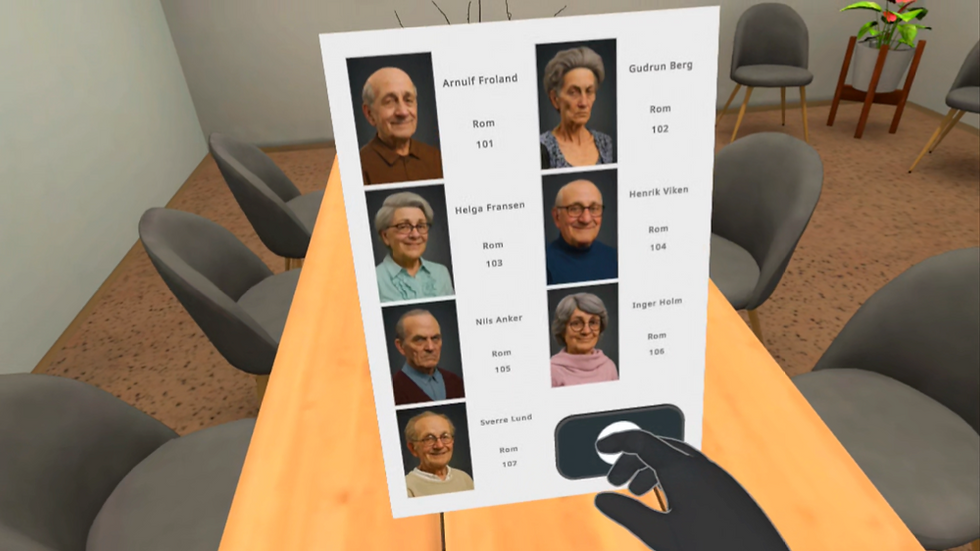
Instead of reading, listening, or practicing isolated sentences, participants learn to use the language in realistic workplace situations. They practice conversations with residents, communication with colleagues, and practical tasks in a simulated work environment.
Conversations can be repeated. The pace can be adjusted. Participants are free to make mistakes, try again, and gradually build confidence.
The goal is to make the training more practical and closely connected to real working life. The conversations resemble those encountered in everyday work situations, for example:
greeting a resident
understanding and responding to a message
asking simple follow-up questions
using polite and reassuring language
communicating with colleagues
explaining a practical task
practicing words and expressions related to routines in health and care services
Volume based Practice
Artificial intelligence is used to adapt the training to each participant’s level and to provide the extensive practice that language learning actually requires. VR is not intended to replace teachers, mentors, or traditional language instruction. It is a new tool that can make training more practical, concrete, and accessible.
For instructors and mentors, VR can provide a structured environment where participants can practice workplace situations before encountering them in real life. For participants, it can create a smoother and more confident transition from training into employment.
When language training is connected to realistic tasks and users are given the opportunity to practice repeatedly, the likelihood increases that the language skills will remain in place when the situation arises in real life.
Developed for Real-World Needs
Good technology starts with the people who are actually going to use it.
That is why the solution is being developed with a strong focus on usability, safety, and practical relevance.
The goal is not to create a general language-learning app, but a tool that is meaningful in real workplace situations.
When participants can practice Norwegian in an environment that resembles the workplace, language training becomes more realistic and relevant. And when instructors gain a new tool for repetitive practice, the training can be more easily adapted to different needs and skill levels.

Who Could This Be Relevant For?
This type of solution may be relevant for:
AFT programs and employment and inclusion enterprises
NAV and other organizations working with workforce inclusion
Norwegian language training and adult education programs
employers within the health and care sector
municipal services
professional environments working with integration, language, and employment
organizations seeking more practice-oriented training programs
The Road Ahead
Language often determines who gains access to working life.
When learning takes place in realistic situations, the path into employment becomes shorter. This leads to more confident employees, better services, and a more inclusive workforce.
If you would like to learn more about how VR can be used for language training, workforce inclusion, and training for non-native speakers in health and care services, please contact us at hello@fornixvr.com.


